Care. · 9 MIN READ
Swimming pond maintenance: a routine you can keep up with
Organise observation, debris removal, equipment checks and seasonal work around the instructions for your own system.
In this guide
Build the routine around your handover
Ask for the care plan for your actual installation. It should distinguish observations you make before use, routine owner tasks and work that belongs to a service professional. Confirm how the schedule changes during periods of heavy use or seasonal leaf fall.
A generic weekly list cannot replace those instructions. It can, however, help you organise them so that looking after the pond becomes predictable rather than reactive.
Before use: notice what has changed
Follow the operating plan’s checks for water appearance, equipment function and access. If something is outside the agreed normal condition, use the escalation steps rather than assuming it will resolve itself.
Keep the water-quality plan alongside the maintenance list. Cleaning an edge or emptying a basket is not a substitute for investigating a concerning water-quality change.
When something fails: first steps before a quick fix
A stopped pump, a broken fitting or an unexpected test result needs a clear first response. Use this sequence alongside the fault procedure supplied for your installation.
1. Pause swimming and observe safely
Pause use while an unexplained circulation failure, damaged fitting or concerning water-quality change is assessed. Keep people and pets away from suspect water. The CDC's natural-water guidance advises staying out when water becomes unusually cloudy, discoloured or foul-smelling.
Observe from dry, stable ground. Do not enter the pond to retrieve a pump, reach into a pipe or handle wet or damaged electrical equipment. Follow the documented safe-stop procedure only where you can operate the designated control safely. Otherwise keep clear and call the responsible professional.
2. Save a useful fault record
Before changing permitted settings, photograph the display and visible problem from that safe position. Start an entry in the pond-care log:
- Time first noticed, last known normal operation, weather and recent rain or frost.
- Exact pump and controller models, regional version, manual reference and displayed fault code.
- Controller mode and setting; whether the pump is silent, sounds different or repeatedly stops.
- Visible return flow, water level and which circuits or features are affected.
- Recent cleaning, filling, power interruption, changed settings or building work.
- Photographs, test results with units and method, actions taken and who took them.
Write “return flow stopped” rather than “motor failed” unless the cause has been established.
3. Use the actual fault instructions
Read the fault table for that model and code. Carry out only the owner tasks covered by the manual and handover, using their isolation and access instructions. Cleaning a basket or filter casing is an option only where those instructions permit it. Do not dismantle a power supply, improvise a repair or keep resetting a trip to force operation.
For example, the US OASE AquaMax Eco Expert 5300 / 7100 / 12 V manual warns that its monitoring functions can restart the unit automatically and requires disconnection before work. Its fault table lists several possible causes; it does not diagnose another model. See the pump guide for model and installation distinctions.
Photograph a split hose, leaking joint or damaged fitting; do not tighten or open an unfamiliar pressurised connection. Use the leak guide to organise accessible water-loss observations. Frozen or damaged equipment belongs on the fault path, not an improvised seasonal restart.
4. Escalate the right problem
Send the installer or authorised service provider the fault record, manual/model details and photographs. Ask what may remain operating, which owner action is permitted and what must be checked before return to service. Electrical damage or repeated protective trips need a qualified electrician; unresolved water-quality changes need the water-quality specialist identified in your care plan.
For an abnormal reading, check the test's instructions, reagent condition, units and sampling method, and retain the original result. Follow the water-quality response plan; a reading alone is not an instruction to add vinegar, baking soda or another household remedy. Suspect growth needs the algae assessment path, not an overnight-clearance promise.
Record the advice, responsible person and next review. A restarted pump or clearer appearance does not by itself authorise swimming after an incident. Reopen according to the agreed assessment, with any required service checks or laboratory results recorded.
Routine work: give every task an owner
Create a checklist for debris removal, the specified skimmer or filter cleaning, surface cleaning and equipment observations. Put the relevant manufacturer instruction next to each task.
Assign responsibility for each job, including what happens when the usual person is away. Record completed work briefly. The point is to support consistent care, not to create an elaborate diary.
Keep suitable tools in a convenient place. Ask the installer which tools are compatible with the liner and finishes, and how to reach the areas that need cleaning without damaging them.
Choose leaf tools for the collection point
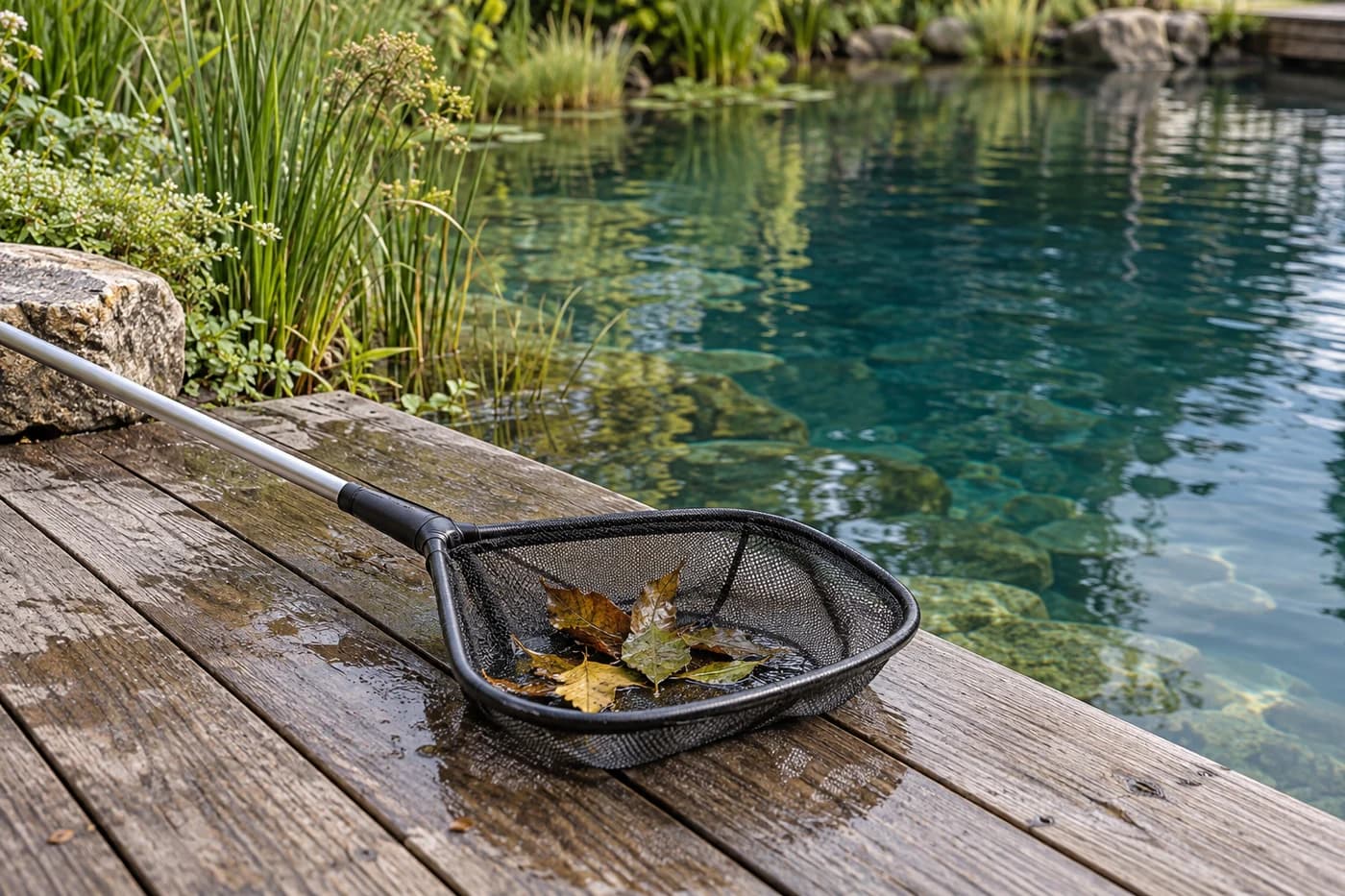
Watch where floating leaves gather and where you can work from firm, dry ground. Choose the tool and a place to empty it together. A net that reaches the far side when empty may still be awkward to lift when loaded.
- Surface collection: an existing skimmer or intake bay can concentrate floating debris for removal. Before adding a skimmer, check its water-level range, required flow, swimming-installation suitability and basket access against the filtration design. It still leaves an emptying task; it does not establish a weekly maintenance interval.
- Hand nets: compare a coarse bag for larger leaves with a fine net for smaller plant fragments. The UK-listed OASE Profi Pond net, for example, offers interchangeable fine and coarse nets and replacement bags. That illustrates useful features, not a universal mesh specification. Check the frame around your lining, the handle lock, usable reach and replacement availability. Do not use it to drag gravel or force material out of planting.
- Temporary leaf cover: consider this when you can keep the pond out of use and safely fit, check and remove the cover. Measure the coverage and attachment area using the exact product's instructions. Ask about wind, snow and accumulated-leaf limits; a supplied peg count is not a load rating. Aquascape's netting instructions call for clearing accumulated debris to prevent sagging. Plan how to do that without entering the water or leaning across an unsupported net.
An ordinary leaf net is not a child-safety barrier or a load-bearing cover. Keep the site's protective arrangements in place and remove the leaf cover before swimming. Use the seasonal-care guide for the wider plan.
Netting also creates wildlife risks. RSPCA guidance advises keeping pond netting taut and checking it regularly. Avoid leaving loose surplus or discarded netting where animals can become tangled. If you cannot maintain and inspect it, choose another collection approach.
Before buying, decide where tools will be cleaned, dried and stored without obstructing access. Check the leaf-net equipment questions, then record actual work and leaf conditions in the care log. Use that record to adjust the agreed routine during heavy leaf fall.
Plant care: make room for maintenance
Follow the planting schedule’s trimming and removal instructions. Keep access points visible and maintain the routes to equipment. Record changes that might help the installer understand how the planted area is developing.
Do not introduce a new additive or “natural remedy” simply because it is sold for ornamental ponds. Check whether the system designer approves it for the intended swimming use.
Professional visits: discuss them early
Gartenart, for example, offers maintenance visits and recommends at least an annual visit for its ponds. That is one contractor’s approach, not a universal interval.
Ask your own installer what service schedule is appropriate, what it covers and which conditions should trigger an earlier visit. Budget for it as part of ownership.
Put the routine where you will use it
Keep the approved checklist beside the equipment instructions. Start each entry with the date and the person doing the check. Record visible debris, changes in water level or appearance, equipment behaviour and any work completed. Do not set a pump duty cycle or clean biological media from a generic internet timetable.
Download the pond-care log. It separates observation, action and follow-up, with space for a photograph or laboratory-report reference. It opens in a spreadsheet, but a paper notebook with the same columns works just as well.
A realistic owner account
Crafts Hill Barn’s owners describe removing seasonal plant material, leaves and blossom, dealing with algae after heavy rain, and finding changes harder once the pond was full. Their account makes an appealing pond feel like a real garden project. It is one accommodation business’s experience, not a promise of your workload or an endorsement of its suggested treatments.
That is why we would ask for two reference visits where possible: one to admire the finished pond, and another to see an ordinary maintenance task. An owner who can show you the job is more useful than an estimate of “a few minutes” with no task attached.
Plan for a week away
Choose a named person, give them the current care sheet and show them which observations matter. Include photographs of normal controls, the support number and the condition that means “stop swimming and call”. Do not leave a guest to experiment with valves or electrical equipment.
Write down which approved tasks may wait and which need cover while you are away. If nobody can take responsibility, arrange the installer’s recommended alternative. Being easy to own includes being possible to leave for a holiday.
Review after the first season
Note which jobs took longer than expected and which instructions were unclear. Ask for a revised routine if needed. A good handover can improve as you learn how the pond fits everyday life.
Use seasonal planning to organise the larger tasks without losing the regular checks.
Choosing cleaning equipment
Before buying a machine, check the floor surface, working reach and where dirty water will drain. Our pond vacuum selection guide compares three documented designs and explains the questions to resolve for a lined or gravel-covered pond.
Investigate unexplained water loss
Record water levels, rain, filling and any cleaning to waste before buying a patch. The swimming-pond leak guide walks through accessible checks and provides an observation sheet for the installer.
Include water-holding items around the garden in your inspection. The mosquito larvae guide explains identification, checking breeding sites and the limits of treatment advice for swimming water. For recurring floating plants, use the duckweed observation guide.
Sources & context
Sources support the points identified in the guide. Supplier material describes that supplier’s approach. Owner accounts are attributed experiences, not independent performance tests.
- Gartenart — Maintenance ↗A contractor’s own aftercare offering and annual-visit recommendation; not a universal servicing interval.
- Crafts Hill Barn — How we built our Natural Swimming Pond ↗First-person account from an accommodation business, originally published May 2023. Useful experience from one site, not a comparative trial.
- OASE: AquaMax Eco Expert 5300 / 7100 / 12 V US manual ↗Manufacturer-authored retailer mirror, checked 18 September 2026. Printed pp. 4–5, 8, 15–18: damaged-equipment restrictions, application conditions, automatic restart, isolation, cleaning and model-specific fault causes. No generic wiring, reset delay or repair procedure is transferred.
- CDC: How to Safely Visit Oceans, Lakes, and Rivers ↗15 May 2024; checked 18 September 2026. Natural-water appearance and contamination precautions. Does not provide a universal private-pond reopening test.
- CDC: Harmful Algal Blooms and Your Health ↗9 January 2024; checked 18 September 2026. Keep people and animals away from suspect water; appearance does not identify every harmful bloom.
- WHO: Guidelines on recreational water quality, Volume 1 ↗13 July 2021. Reuses the reviewed water-quality guide’s management and monitoring evidence. The fault-response workflow is an editorial proposal for an installation-specific plan, not a universal legal shutdown or reopening rule.
- OASE: Profi Pond net, UK listing ↗Official page checked 18 September 2026. Interchangeable fine/coarse nets, telescopic handle and replaceable bags are documented features; no universal mesh size, lifting load or liner compatibility is inferred.
- OASE: AquaSkim 40, UK listing ↗Official page checked 18 September 2026. Documents an accessible debris basket and model-specific water-level/flow requirements. Mixed family descriptions mean numerical sizing claims are not adopted; this is not swimming-installation approval.
- Aquascape: Protective Pond Netting instructions and maintenance ↗Manufacturer instruction sheet marked04/18, US/Canada. Supports removing accumulated debris to prevent sagging; no load, weather or safety-cover approval is inferred.
- RSPCA: Wildlife-friendly gardening ↗Current official animal-welfare guidance checked 18 September 2026. Pond netting should be taut and checked for wildlife risks. This is not an engineering design or child-safety standard.
- CPSC: Safety Barrier Guidelines for Residential Pools ↗US Publication 362, historical booklet. Printed p. 14 discusses safety-cover performance requirements; an ordinary debris net is not thereby approved. No old standard edition or barrier dimension is presented as current worldwide law.