Care. · 6 MIN READ
Duckweed in a pond: identify it and manage the spread
Tell duckweed from algae, plan manageable removal and investigate recurring growth without guessing which treatment your swimming pond needs.
In this guide
Duckweed is a tiny floating plant, not algae. In a swimming pond, start by checking what the green covering actually is, then remove excess growth and investigate why it keeps returning. Buying an algae treatment before identifying the plant can send you down the wrong route.
A few floating fronds and a thick covering across the swimming area are different management problems. Record the extent first. Your goal is to keep the pond usable and its treatment system working, with a maintenance routine you can sustain.
Is it duckweed, watermeal or algae?
Look closely from a safe edge. Minnesota DNR's duckweed and watermeal guide offers useful distinctions:
- Duckweed usually appears as separate tiny green, leaf-like bodies, sometimes joined in small clusters, with fine roots hanging into the water.
- Watermeal resembles much smaller green grains and has no roots. It can occur alongside duckweed.
- Filamentous algae forms connected strands rather than separate floating plants.
For photographs of different duckweeds, use the RHS identification guide. Some species are difficult to distinguish, so a distant photograph of a green surface is not a firm identification.
Photograph the whole affected area and a close-up with a size reference. If it looks like coloured scum or a paint-like film rather than identifiable plants, use the algae investigation guide and keep people and pets out while a suspected harmful bloom is assessed. Do not handle an unidentified bloom to try this comparison.
Why has it appeared so quickly?
The US Forest Service's account of common duckweed describes rapid reproduction through vegetative buds. It also notes that identification to species can be difficult. A spreading patch does not mean someone has deliberately planted it.
RHS describes warm, nutrient-rich, still or slow-moving water as favourable conditions. Duckweed can arrive with newly introduced aquatic plants. That makes recent planting, calm corners and changes in water inputs useful things to investigate, rather than proof of a single cause.
Write down when you first noticed it, where it collects and what changed beforehand. Include plant purchases, top-ups, heavy rain, garden work and interruptions to equipment. These notes make a discussion with your pond designer more productive than “the water has gone green.”
Decide where growth is causing a problem
Mark the affected areas on a simple plan: swimming space, entry steps, collection points and planted treatment areas. Take repeat photographs from the same place so you can compare coverage over time.
Duckweed has ecological value as food and habitat, but dense cover can shade submerged plants, as Minnesota DNR explains. That does not translate into a universal acceptable percentage for a swimming pond. Agree the intended condition of each area with the treatment designer.
Do not infer bathing-water safety from the amount of duckweed. Keep the water-quality monitoring plan separate from deciding how much surface growth to remove.
Remove excess without turning it into a major rebuild
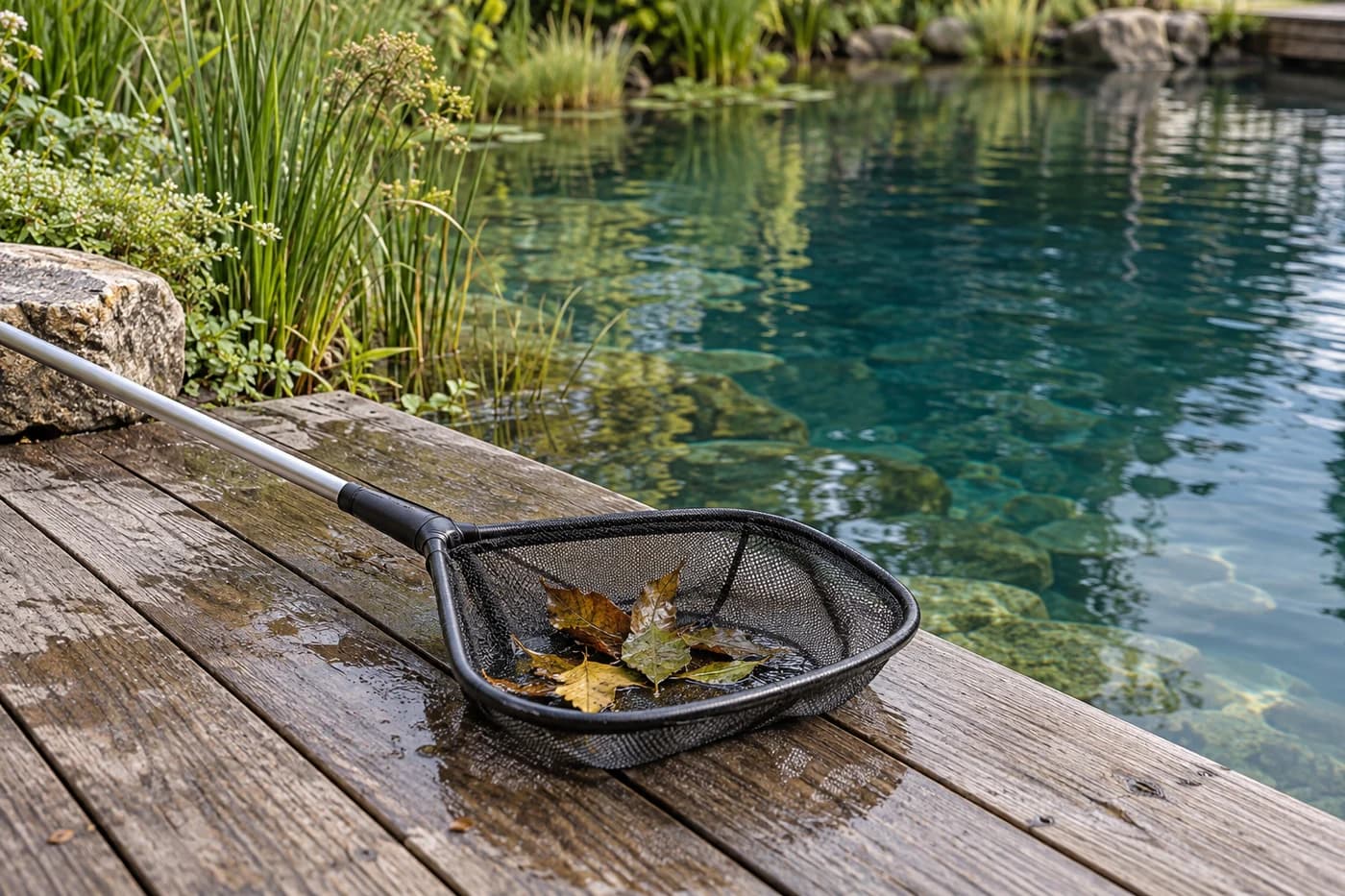
RHS recommends regular removal with a net or rake and describes a floating boom as an option for gathering growth on larger ponds. Begin with a manageable area and see whether your chosen net actually retains the plants you have identified.
For the swimming-pond setting, use this practical sequence:
- Choose a stable access point where you can work without leaning far over the water or entering the planted treatment bed.
- Lift a small amount first. Check the retained material for pond animals and assess how heavy and awkward the loaded net becomes.
- Work in manageable passes and keep removed material in a container rather than leaving it where it will wash straight back.
- Check collection baskets and other accessible inlets using their normal maintenance instructions.
- Record the time spent and how quickly the surface covering returns. Adjust the routine from those observations.
A boom or other temporary collection aid should be removed before swimming and must not obstruct an inlet or exit. Do not fit fine mesh over a powered intake as an improvised duckweed filter; have any change to that circuit assessed first.
For a net, compare mesh retention, comfortable reach, loaded weight and replaceable parts. The largest net is not necessarily the easiest to empty. These are buying criteria, not a tested product ranking. The equipment checklist helps organise maintenance tools alongside the rest of the system.
Investigate repeated nutrient inputs
The Pond Conservation guidance hosted by Freshwater Habitats Trust identifies recurring nutrient inputs as an important cause of persistent growth. Its examples include fertiliser runoff, disturbed soil, animal feeding and nutrients in incoming or top-up water. It is wildlife-pond guidance, not a swimming-water standard.
Walk the pond boundary after rain and note where water enters. Compare those routes with recent fertilising, exposed soil or changes to drainage. Record the top-up source and discuss any appropriate testing with the designer. Removing the visible plants will not, on its own, identify an ongoing input.
Also review leaf and plant-debris removal in your maintenance routine. Keep this investigation targeted: an unexplained patch does not automatically justify replacing the pump, emptying the pond or changing all the filter media.
Prevent easy reintroduction
RHS recommends keeping newly bought or shared aquatic plants separately for observation before adding them to a pond, removing duckweed that appears. Keep a record of the plant supplier and inspect new additions before they enter your planned planting zones.
Use the swimming-pond planting guide when reviewing the wider planting plan. Do not transfer pond water or unidentified plants from another site as a shortcut to creating a mature ecosystem.
If physical removal is becoming an unreasonable job, take the identification, photographs and maintenance record to an aquatic specialist. Any proposed treatment needs to fit the species, local requirements and the fact that people swim in this water. An ornamental-pond product description is not enough to make that decision.
Keep a short record of what worked
Use the duckweed observation sheet to record coverage, removal time, weather, new plants and water inputs. After several observations, you will have a useful record of where it returns and what demands the most work.
The next step should follow that evidence: a better collection tool, a more workable routine, investigation of an input or advice on the treatment design. It should not depend on finding a product that promises to make every green pond clear.
Sources & context
Sources support the points identified in the guide. Supplier material describes that supplier’s approach. Owner accounts are attributed experiences, not independent performance tests.
- Minnesota DNR: duckweeds and watermeal ↗Identification clues and ecological role; not a bathing-water assessment or a treatment prescription.
- RHS: duckweed ↗Garden-pond identification, manual removal, growth conditions and observation of new plants; adapted to a swimming-pond enquiry without universal coverage targets.
- US Forest Service: common duckweed ↗Botanical account of vegetative reproduction and identification limits.
- Pond Conservation: problems with algae and duckweed ↗March 2010 wildlife-pond guidance on nutrient inputs; not swimming-water standards or a current pesticide recommendation.