Build. · 9 MIN READ
Swimming pond plants: depth, growth and placement
Choose plants by growing position, mature spread and local rules. Includes five UK examples and checks for your nursery order.
In this guide
Choose swimming pond plants for a specific growing position, mature size and care plan. Start with the treatment layout and local growing conditions, then match each candidate to a place on the drawing.
This guide helps you read planting depths, check roots and growing media, and prepare a nursery order. Five UK examples make the questions concrete; suitability elsewhere still depends on the region and the proposed system.
Give each planted area a job
Mark which areas belong to water treatment and which provide garden interest, shade or habitat. Keep the swimming route, entry and service points visible on the drawing. Read the filtration guide alongside it so planting follows the actual treatment arrangement.
The IOB Common Essentials separates treatment and bathing areas and addresses plant sourcing and nutrient inputs. It is association guidance, not a species recipe or a promise that plants alone make water suitable for swimming.
Ask the designer to explain why each proposed plant belongs in that position. If its only documented role is visual, record that. A flower colour is a reasonable landscaping preference, but it does not establish a treatment duty.
Choose the growing position before the species
The RHS selection guide distinguishes several aquatic growing positions. For a swimming-pond discussion, translate them into places on your drawing:
- Damp garden planting outside the water needs its own soil and moisture conditions.
- Shallow marginals root near the water's edge, with the permitted depth checked for each plant.
- Deep-water rooted plants need a suitable planting position as well as room for their leaves.
- Free-floating plants occupy the surface; submerged plants grow beneath it. Include either only where the design allows them.
These groups describe growing habits, not a required shopping list. Preserve open swimming space and access to baskets, covers and inspection points.
Record sunlight and shade at the proposed location before selecting plants. The site-suitability worksheet helps gather those observations. A photograph taken at midday cannot describe seasonal shade from surrounding trees.
Put the depth reference on the schedule
Ask the nursery what its quoted planting depth measures: water above the crown, the growing medium or another stated point. The crown is the region where roots and shoots meet. Keep that reference beside the plant's name.
Here is an illustrative measurement, not a species recommendation. If a shelf is 30 cm below the normal water level and the installed plant's crown is 20 cm above the shelf, water covers the crown by 10 cm. The shelf depth and the growing depth are different measurements.
Show the container or root-ball height, planting medium and intended water level together. Ask whether the expected operating-level variation still suits the plant. Have the designer specify any support needed to achieve that level while keeping the swim area and service route clear.
Agree the roots, containers and medium together
A treatment bed, a removable planted basket and a damp garden border can require different growing media. Obtain the written specification for each position, including what arrives with nursery-grown stock and who prepares it for installation.
The RHS aquatic-planting guide describes baskets and loam-based media for ordinary pond planting. Those instructions do not automatically fit a specified swimming-pond treatment bed. Check any proposed soil, compost, fertiliser, basket liner or aggregate with the system designer.
For a basket, confirm its dimensions, support and removal route. Ask how mature roots will be managed and whether the container can still be lifted when planted. Container-grown does not mean maintenance-free.
For direct planting into treatment media, identify the allowed position and method before disturbing the bed. Keep plant work clear of distribution pipes and service components. Add aquatic plant baskets to the equipment shortlist only if the agreed detail uses them.
Check mature spread as well as first-season appearance
Write down expected height, spread and the way each candidate expands. Ask whether it forms a manageable clump, extends through rhizomes, spreads over the water or readily seeds into nearby positions.
Waterside Nursery's swimming-pond advice distinguishes upright and spreading plants on a gravel shelf. It is a UK supplier's approach. Its planting densities and suggested species are not a specification for every swimming pond.
Our preference for a compact edge is a planting scheme whose mature growth can be reached and controlled. Draw the space needed for that work before filling every gap.
Have the designer or nursery state the initial quantity and spacing for each position, and explain how the planting is expected to develop. A larger online bundle is only useful if its plants have suitable assigned places.
Five plant examples for a UK temperate garden discussion
These examples give a UK temperate-garden discussion some concrete names. The linked RHS profiles describe horticultural habits and growing conditions; the placement questions below are ours. They do not establish a plant's treatment performance or approve it for a particular swimming system.
Use each name to discuss a position already shown on your drawing. Confirm the exact species or cultivar, mature growth and supplied root-ball size with the nursery. Where a supplier quotes a water depth, ask which point it is measured from.
- Caltha palustris, marsh marigold, forms clumps with rounded leaves and yellow spring flowers. RHS places it in sunny, boggy ground at the water's edge. It is an example to discuss for a wet edge where the crown position and medium can be specified. Ask whether that location stays suitably moist through normal water-level changes and remains reachable for seasonal plant work.
- Myosotis scorpioides 'Mermaid', water forget-me-not, is a compact marginal cultivar with upright or partly upright stems and blue flowers. RHS describes wet pool margins in sun or partial shade. For a low planting pocket, ask the nursery to define the crown's water-depth range for this cultivar, then check the installed container height against the shelf drawing.
- Mentha aquatica, water mint, spreads through long rhizomes and produces aromatic foliage and pink-purple flowers. RHS describes muddy margins or baskets in a large pond and warns that unmanaged growth can become troublesome. Before assigning it an edge, ask how spreading roots will be inspected and controlled, and whether the agreed container can be removed without disturbing the treatment bed.
- Butomus umbellatus, flowering rush, supplies an upright, deciduous marginal form with narrow leaves and pink flower heads. RHS describes sunny pond margins and rhizomatous growth. Ask whether the mature stems fit the sightline and whether its roots can be managed in the proposed position. Regional status matters particularly here: Minnesota lists flowering rush as a prohibited invasive species. Its inclusion in this UK discussion is not a recommendation to order it elsewhere.
- Nymphaea 'Pygmaea Helvola', a miniature waterlily, has floating, blotched leaves and small yellow flowers. RHS specifies sunny, undisturbed water and basket cultivation. Discuss it for an ornamental water pocket only if the system allows that use. Ask how the basket's depth reference, growing medium and eventual leaf spread fit the design while leaving swimming and service access clear.
For the final shortlist, resolve the region check alongside the growing-position check. The England and Wales invasive-plant guidance covers specified restrictions; absence from one list does not establish permission for every destination or activity. Keep the supplier's handling advice with each plant entry. The RHS profiles' ornamental growing-media and feeding instructions also need review against the swimming system's specification.
Check identity and local restrictions before ordering
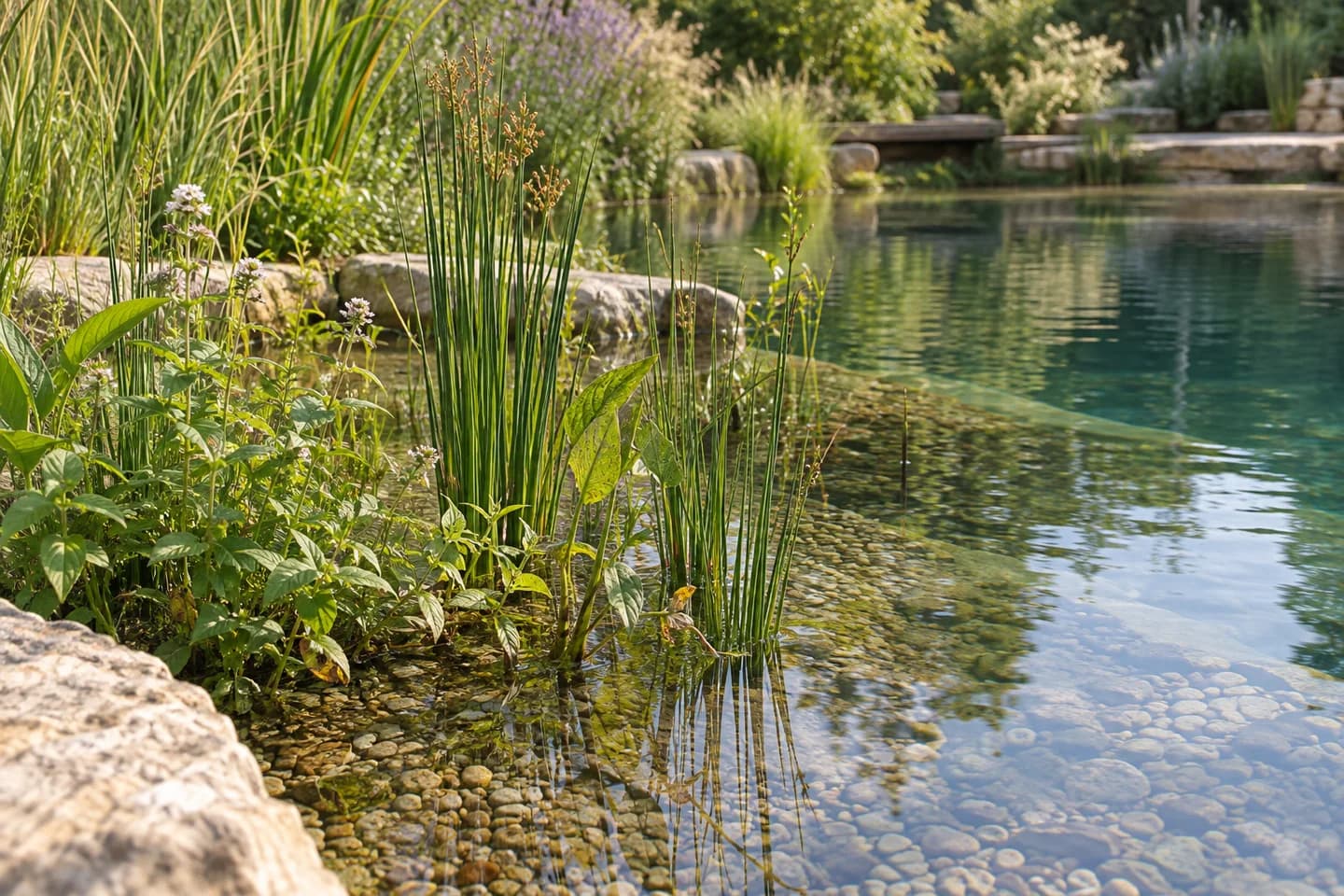
Use the full botanical name and cultivar where relevant. Common names, a seller's photograph and our illustrative cover image cannot reliably establish what is being supplied.
"Native" must refer to a place. Check the species against your region's conservation or extension guidance, then check current restrictions with the responsible plant-health or environmental authority. Native status alone does not tell you how easily a plant can be managed in a small bed.
For example, England and Wales regulate listed invasive plants, including activities beyond sale. In the US, APHIS distinguishes federal and state restrictions. These examples do not determine the rules for another destination.
Buy clearly identified cultivated stock with a traceable supplier. Check movement and import requirements before ordering across borders. Availability in an online shop is not evidence that the plant is permitted at your address.
Inspect arrivals before they enter the pond
Match labels and quantities to the approved order. Check for substitutions, unwanted plant fragments and unidentified growth among the purchased plants.
The RHS recommends keeping new pond plants separate for observation because unwanted aquatic plants can arrive with them. Its aquatic-weeds guidance explains the difficulty of controlling some established species. Agree suitable holding conditions with the nursery and resolve doubtful identity before installation.
Keep packaging details, purchase date and photographs in the planting record. Do not release surplus plants or contaminated holding water into drains or watercourses. Follow local disposal advice for unwanted or restricted material.
Investigate poor growth before adding nutrients
Record the plant, position, water depth, symptoms and recent changes. Ask whether the plant is establishing normally for the conditions and whether its placement or supplied medium differs from the specification.
Keep source-water information and the agreed water-quality measurements with that record. IOB calls for analysing fill water and limiting unwanted nutrient inputs through materials; adding fertiliser to improve one plant needs review within the whole system.
If plant work coincides with green water, use the algae diagnosis guide to record the sequence. Changing planting, feeding and equipment together makes the result harder to interpret. Healthy-looking plants cannot substitute for the swimming-water monitoring plan.
Make the purchase include a care plan
Before payment, obtain the exact identities, quantities, supplied sizes, planting positions, depth references, medium, approved substitutions and delivery conditions. Agree who checks the plants and installs them.
For each group, record what to remove, divide, retain or protect, and the conditions that trigger that work. Ask how cut material will leave the pond and how work around the roots avoids damaging the liner or treatment layout. Transfer those tasks into the maintenance plan and use the seasonal-care guide for the wider operating review.
Keep the final planting drawing and replacement notes. A future order should be traceable to a known position and purpose, rather than a guess based on what flowered last summer.
When checking newly introduced plants, use the duckweed identification and management guide to record any unwanted floating growth before it spreads through the pond.
Sources & context
Sources support the points identified in the guide. Supplier material describes that supplier’s approach. Owner accounts are attributed experiences, not independent performance tests.
- RHS: Choosing pond plants ↗Checked 18 September 2026. Growing positions, mature vigour, depth selection and observing new purchases. General pond advice; its surface-coverage targets and species lists are not a swimming-pond treatment specification.
- RHS: Aquatic plants, planting ↗Checked 18 September 2026. Explains baskets, growing media and different plant positions for ordinary garden ponds. Its media, fertiliser, density and planting-time advice is not transferred as a universal swimming-pond instruction.
- RHS: Aquatic weeds ↗Checked 18 September 2026. Retained evidence for nuisance growth and difficulty controlling established aquatic plants. UK horticultural context, not a worldwide legal list or chemical-treatment recommendation.
- IOB: Common Essentials ↗Member agreement dated 7 October 2021; checked 18 September 2026. Treatment-area separation, cultivated plant sourcing, local invasive status, nutrient inputs and fill-water analysis. Association guidance rather than a universal species recipe or project certification.
- Waterside Nursery: Planting a swimming pond ↗Undated UK commercial nursery advice, checked 18 September 2026. Upright and spreading planting forms used as a design example. Its densities, species and treatment-performance claims are not adopted as universal recommendations.
- Defra and APHA: Invasive plant rules in England and Wales ↗Updated 18 November 2024; checked 18 September 2026. Regional example of restrictions on listed plants and preventing spread through fragments or waste water. No species-level legal clearance is given for the reader's order.
- USDA APHIS: Federal Noxious Weeds ↗Updated 30 July 2025; checked 18 September 2026. Identifies federal controls and directs readers to state restrictions. US example only; no import permission or worldwide plant list is inferred.
- RHS: Caltha palustris ↗Undated profile, checked 18 September 2026. Clump-forming marginal, rounded leaves, yellow flowers and sunny boggy-edge cultivation. Horticultural information only; no swimming-system placement or treatment performance is certified.
- RHS: Myosotis scorpioides 'Mermaid' ↗Undated profile, checked 18 September 2026. Compact marginal cultivar, upright or semi-upright stems, blue flowers and wet pool margins in sun or partial shade. No numerical depth is copied because the reference point needs clarification for the installed detail.
- RHS: Mentha aquatica ↗Undated profile, checked 18 September 2026. Rhizomatous spread, muddy margins or baskets in a large pond, with a nuisance-growth caution. Conflicting height descriptions on the page are not repeated; no containment or suitability guarantee is inferred.
- RHS: Butomus umbellatus ↗Undated profile, checked 18 September 2026. Upright marginal habit, deciduous foliage, pink flower heads, full sun and rhizomatous growth. UK horticultural example; destination restrictions remain separate.
- RHS: Nymphaea 'Pygmaea Helvola' ↗Undated profile, checked 18 September 2026. Exact miniature cultivar with floating blotched leaves, yellow flowers, sunny undisturbed water and basket cultivation. Its depth sequence, ornamental soil and feeding instructions are not transplanted into a swimming-pond treatment specification.
- Minnesota DNR: Invasive species laws ↗Undated official page, checked 18 September 2026. Lists Butomus umbellatus as a prohibited invasive species in Minnesota. This narrow example does not establish rules elsewhere or clear any other plant or shipment.