Care. · 11 MIN READ
Swimming pond algae: green water, strands and warning signs
Describe the growth, recognise reasons to stop swimming, investigate recent changes and choose the next maintenance or testing step.
In this guide
Start by describing where the growth is: suspended through the water, attached in strands, or gathered in a surface patch. Then decide whether this is a possible health incident or a maintenance problem already identified in your pond's care plan. Choosing a treatment before making that distinction can leave the real cause unresolved.
This guide gives you a sequence for observations and follow-up. It cannot identify an organism or certify bathing water from a photograph.
1. Check for reasons to stop swimming
Keep people and pets out when there is an unexplained change in colour, scum, paint-like streaks, suspect mats or an unpleasant smell. Follow any existing stop-use instruction for your installation. Photograph the change from a dry, stable edge without touching the material.
The CDC's harmful-bloom overview explains that some blooms produce toxins and that harmful growth can occur below the surface. A clear patch between visible accumulations is not a reliable place to resume swimming.
Contact the installer and the relevant local environmental-health or water-quality service for assessment and sampling advice. A private pond may not be included in routine public monitoring. If someone becomes unwell after possible exposure, seek medical advice; if a pet becomes ill, contact a veterinarian promptly. These are exposure precautions, not a diagnosis. The CDC's prevention guidance also advises rinsing off with tap water after contact with suspect water.
Do not test suspect material by touching, tasting or deliberately smelling it. Leave its collection to the procedure agreed with the laboratory or adviser. Establish who will decide when the pond can reopen, as described in our water-quality guide.
2. Describe the symptom without assigning a species
Use the following descriptions to organise the investigation. They overlap: a pond can have more than one kind of growth or suspended material at the same time.
Green water throughout the pond
Fine algae suspended in water can give it an even green appearance. Record whether the colour affects the whole swimming area, just one compartment or the water emerging from a feature. Note when the bottom became harder to see and whether that changed after rain, filling or maintenance.
The RHS distinguishes suspended algae from filamentous growth. Its garden-pond descriptions help explain what you are seeing; they do not establish the safety of swimming water. Treat a new unexplained discolouration under the stop-use section above.
Long strands or growth attached to surfaces
Hair-like strands on plants, edges or the bottom are often described as string algae, blanket weed or filamentous algae. Record where they are attached, how far they extend and whether they are obstructing a known water route.
Do not use “string algae” as proof that a mat is harmless. If the material is unfamiliar or there are other warning signs, seek identification before handling it. Routine removal instructions apply only once the material and appropriate maintenance response have been established.
Scum, paint-like patches, unusual mats or foam
These can be warning signs of a harmful bloom. Cyanobacteria, often called blue-green algae, do not always look blue-green. The CDC's recognition guide shows several appearances and explains why visual inspection cannot confirm whether toxins are present.
Do not diagnose cyanobacteria from a colour chart, or rule it out because a photograph looks different. Record the appearance and location, keep people and pets away, and obtain the appropriate assessment.
Brown cloudiness, settled material or an unexplained film
Record this separately rather than automatically calling it algae. Note nearby soil disturbance, additions of gravel or planting material, recent cleaning and changes in the top-up source. These are possible leads, not proof of the cause. Send photographs and the event history to the installer if the explanation is uncertain.
3. Reconstruct what changed
Copy or save the algae observation sheet. Take a wide photograph and a closer view from the same accessible position on each observation date. Keep the original colour and record the time, weather and equipment state.
Use the browser worksheet or download the five-page A4 PDF. The PDF is a paper worksheet to fill by hand; the browser version remains available for reading on screen. Neither collects entries online.
Look through the previous week's records and extend the timeline if the change began earlier:
- Rain and any visible route from surrounding ground into the pond.
- Lawn or border feeding, exposed soil, construction work or changed drainage.
- Added plants, planting media, gravel, decorative materials or water.
- Leaves, dead plant material or other debris awaiting routine removal.
- Pump interruptions, alarms, changed settings or unusual water distribution.
- Filter cleaning, vacuuming, treatments and other maintenance.
- Changes in swimming use and animal visits.
The CDC describes nutrients and environmental conditions as contributors to blooms. Investigating runoff and nutrient inputs is therefore useful. It does not establish which input caused the change in your pond.
A concrete record helps: “Rain crossed the north edge on Tuesday; cloudiness appeared on Thursday; the pump setting was unchanged.” Keep the observation separate from the question: “Should that drainage detail and our sampling plan be reviewed?”
One site's experience after rain
Crafts Hill Barn's May 2023 account describes continuing nutrient and algae problems after a very wet April. It is an accommodation operator's experience of one swimming pond, not a controlled comparison. It supports asking about the surrounding land and seasonal events; it does not validate their proposed products or construction choices for another property.
4. Follow the appropriate maintenance path
Once a suspect bloom has been assessed and the installation's routine maintenance response applies, concentrate on the work that has a defined purpose.
For debris accumulation, use the existing leaf and plant-litter removal schedule. Record what was removed and where. For identified filamentous growth, ask which tool and method suit the liner, planting and access. RHS describes physical removal in garden ponds, but a rake or sharp tool from that context is not automatically suitable for a lined swimming pond.
For a changed return flow or equipment warning, check the controller indication and the maintenance instructions. Record accessible observations and contact the installer if the normal condition cannot be restored through the approved routine. Increasing a pump setting without checking the system does not diagnose the cause.
For recurring runoff, give the designer photographs of the water route during the event. For changes after planting, retain the plant and substrate details. Our plant selection guide helps frame questions about the intended treatment zone. Adding more plants or shading the pond needs to fit the actual design, access and maintenance requirements.
Avoid deep-cleaning biological media or shutting down treatment as an experiment. Use the filtration guide to identify the debris-removal stage, biological stage and service access before discussing a change.
5. Choose measurements that answer a question
A number is useful when you know what it measures, how it was obtained and what decision it can support. Ask the adviser to specify:
- The question: organism identification, nutrient inputs, a change in operating conditions or a bathing-water concern.
- The sample location and timing.
- The test method, relevant range and reporting units.
- The handling, storage and delivery procedure for a laboratory sample.
- Who will interpret the result and what further checks may be needed.
A general pond chemistry kit does not become a toxin test because the readings look satisfactory. Check the actual analytes listed by the manufacturer. Record measurements through the water-quality checklist; use the sampling service appropriate to the concern rather than assembling a collection of unrelated test kits.
6. Buy for the identified job
A useful purchase should match the work agreed for this installation:
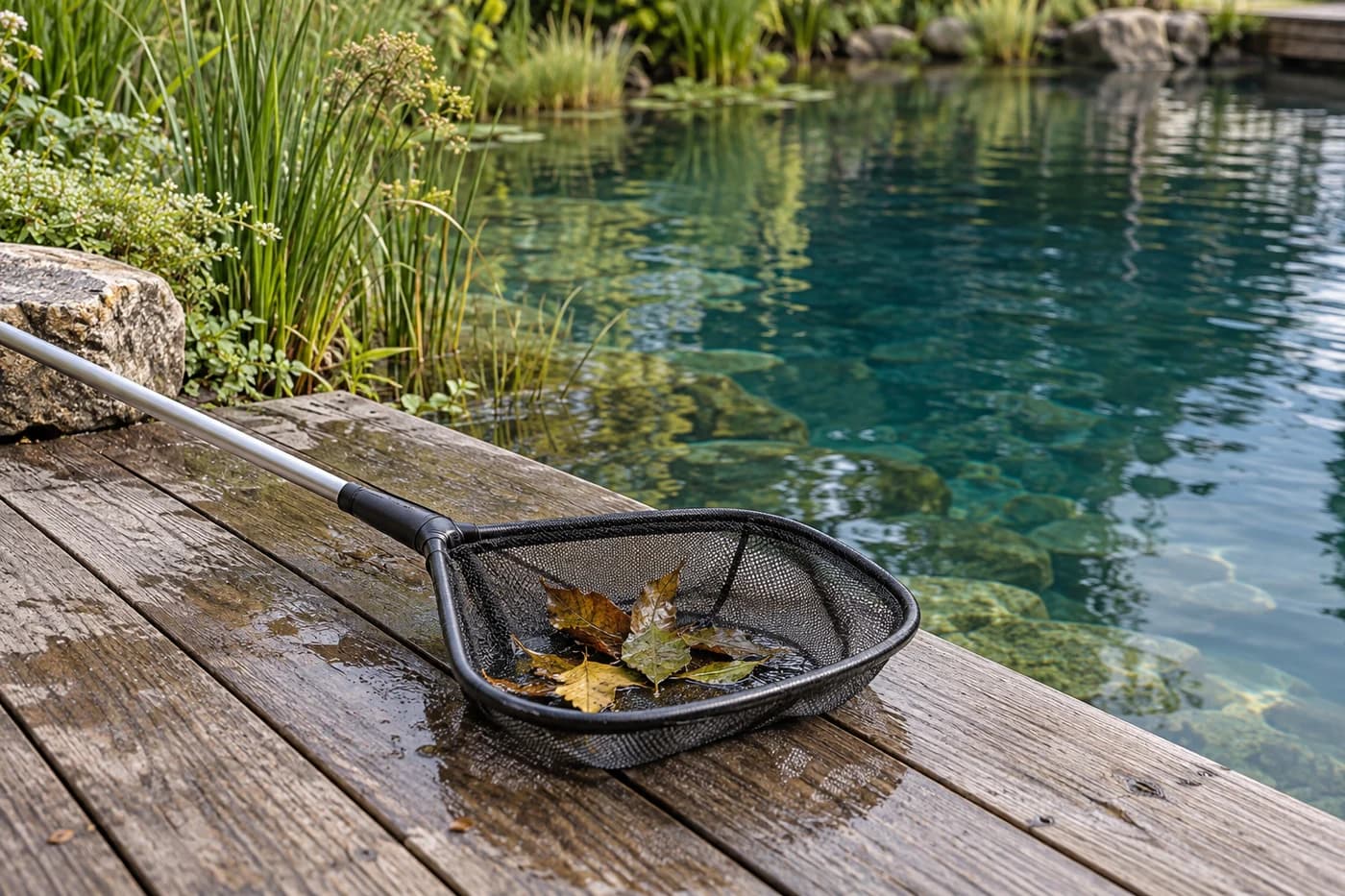
- A suitable leaf net or skimming tool for routine debris removal.
- A pond vacuum with a liner-compatible head, sufficient working reach and an agreed waste-water route.
- A replacement service part identified in the equipment instructions.
- A specified test or sampling service that answers the investigation's question.
Our vacuum guide explains the surface, reach and discharge checks. The equipment checklist helps organise selected tools and parts; it is not a basket of algae cures.
Before buying a clarifier, additive or treatment, ask what material it targets, how its performance will be checked and whether the exact product is approved for this swimming-pond system and local use. A promise of clear water does not answer the reopening question.
Do not apply ornamental-pond algaecide, dye, salt, fertiliser or bacterial additives simply because a label says “natural”. Retain the written specification if a qualified adviser recommends an intervention.
Before adding a natural clarity treatment
Barley straw, chitosan and moringa appear in advice about making water clearer. Their evidence comes from different preparations, organisms and settings. The sources below do not establish a homemade treatment protocol for swimming ponds. Clearer water does not establish microbial safety or rule out algal toxins.
Barley straw
Purdue Extension's barley review, revised in August 2002, describes inconsistent results across laboratory, tank and field work. Some algae responded differently from others; reduced microscopic growth sometimes accompanied increased mat-forming growth. It describes the proposed action as inhibiting growth rather than reliably removing an existing bloom. This older review cannot establish today's product approval or a dependable treatment timetable for your swimming pond.
Chitosan
Chitosan is studied as a coagulant, helping material aggregate for removal. In a 2020 laboratory study of eight Microcystis strains, responses varied, and researchers found cell damage and release of microcystins, a group of toxins, under tested conditions. That does not predict what every formulation will do in every pond. It does show why a claim about removing visible cyanobacteria is insufficient: an adviser must also consider cell damage and dissolved toxins.
Moringa seed preparations
A 1987 study of moringa seed coagulation followed turbidity and selected bacteria over 24 hours at 30°C. Initial reductions were followed by regrowth of some bacteria in the water above the sediment. This was a water-treatment experiment, not a swimming-pond trial. Its results do not establish lasting disinfection or provide a bathing-water treatment schedule. A photograph of settled, clearer water would leave those questions unanswered.
Leaf enzymes
“Leaf enzymes” does not identify a particular enzyme, ingredient list or preparation. Without those details, there is no defined treatment to assess. We did not find an identifiable swimming-pond method supporting this phrase in the material reviewed. Ask for the exact formulation and its evidence before considering it.
Questions to settle before buying or adding anything
Take the proposed treatment to the person responsible for the pond's water-quality plan. Ask:
- What has been identified in this pond, and what measurable problem would this treatment address?
- Is the evidence for this exact preparation and intended use? A laboratory result, ornamental-pond instruction or fish-safe claim does not by itself establish bathing suitability. Ask for the applicable swimming-use documentation and local requirements.
- What must happen to the settled or captured material, and how will the intervention affect the existing treatment system?
- Which observations or tests will show whether it worked, and who decides when swimming can resume?
Keep the answers with the product instructions and incident record. If the material has not been identified, return to the diagnostic steps above before choosing a clarifier. If a bloom is suspected, keep the swimming pause and professional assessment in place; visible improvement alone does not resolve it. The water-quality guide explains the separate roles of owner chemistry tests and laboratory work.
7. Record the response and the reopening decision
Keep every necessary intervention in one dated log. If several things must change together, record them all; a later improvement cannot show which individual change caused it. Never delay necessary action to create a cleaner experiment.
Compare photographs from the same viewpoint and keep the care work separate from the health assessment. Record time spent removing material, repeat visits and any operating interruptions. This gives the designer something concrete to investigate when a problem keeps returning.
There is no universal “wait three weeks” or “wait three summers” instruction here. A young system still needs a commissioning plan and a response to warning signs. Ask for the expected observations, review date and escalation criteria for your particular design.
Record the advice received, laboratory results, repair or maintenance work, and the person responsible for reopening. Improved appearance alone does not close a suspected bloom incident. Keep the completed sheet with your maintenance records and use the existing care log for ongoing observations.
A surface covering made of separate tiny plants needs a different identification route from an algal film. Our duckweed guide explains the clues, manageable removal and how to track recurring growth.
Sources & context
Sources support the points identified in the guide. Supplier material describes that supplier’s approach. Owner accounts are attributed experiences, not independent performance tests.
- CDC: Harmful Algal Blooms and Your Health ↗Public-health overview, 9 January 2024. Supports precautions around suspected blooms, not a private swimming-pond certification or operating threshold.
- CDC: How to Recognize a Harmful Algal Bloom ↗Recognition guidance, 8 March 2024. Appearance is not a toxin diagnosis; some harmful growth can occur below the surface.
- CDC: Preventing Illnesses Caused by Harmful Algal Blooms ↗Exposure precautions and professional help, 22 March 2024. Local reporting and reopening procedures vary.
- CDC: Harmful Algal Blooms — Contributing Factors and Impacts ↗18 April 2024. Nutrients and environmental conditions are contributing factors, not proof of the cause in an individual pond.
- RHS: Pond Algae and Blanket Weed ↗Garden-pond descriptions of suspended and filamentous algae and routine physical removal. Product suggestions, dimensions, plant ratios and water-source advice are not transferred to swimming ponds.
- Crafts Hill Barn: How we built our Natural Swimming Pond ↗First-person accommodation-business account, 31 May 2023. Rain-related maintenance experience from one property; proposed treatments and safety claims are not independently validated.
- Purdue Extension: Barley Straw for Algae Control, APM-1-W ↗Revised August 2002; checked 18 September 2026. Dated specialist evidence, not current regulatory advice or a bathing-pond protocol.
- Mucci and colleagues: Chitosan as a Coagulant to Remove Cyanobacteria Can Cause Microcystin Release ↗10 November 2020; checked 18 September 2026. Laboratory findings, not bathing approval. Toxin analysis involved four of the eight strains.
- Madsen, Schlundt and Omer: Effect of water coagulation by seeds of Moringa oleifera on bacterial concentrations ↗June 1987; abstract checked 18 September 2026. Full paper not reviewed; no swimming-pond application established.