Build. · 14 MIN READ
Swimming pond liners: choosing EPDM, PVC or polyethylene
Compare liner materials, size a preliminary sheet and check underlay, seams, fittings, repairs and warranty before ordering.
In this guide
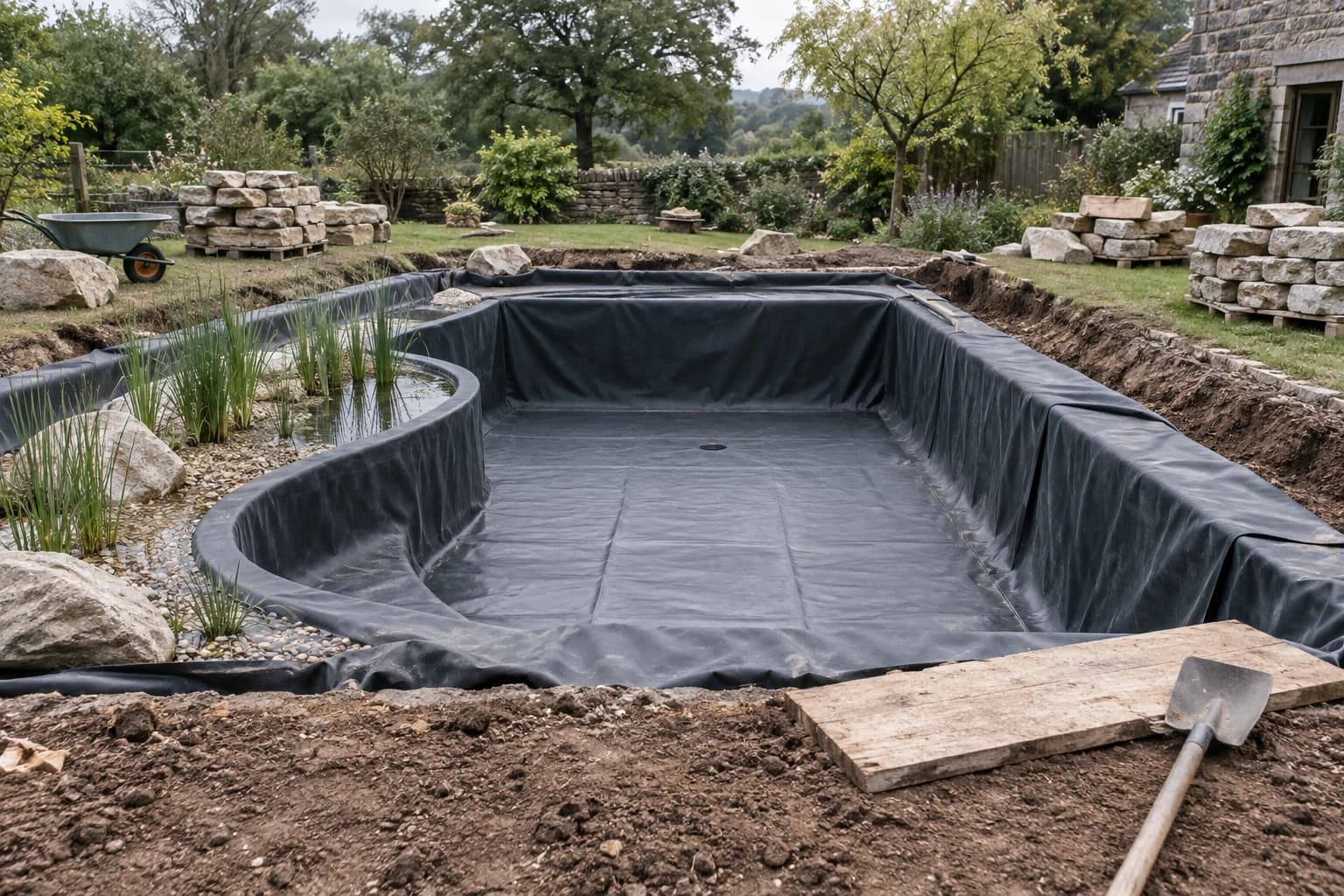
A swimming pond liner is difficult to replace once the edges, planting beds and access steps are finished. Choose it with those details in view. The useful comparison is between complete lining proposals: the named membrane, its protection, the joints and the person responsible for installing them.
This guide compares documented product types and the questions worth settling before ordering. We have not tested these liners against one another. Product examples identify systems to investigate, rather than a ranked list of winners.
Which pond liner is best for a swimming pond?
Our starting shortlist would be pond-specific EPDM and reinforced PVC products whose manufacturer explicitly describes natural swimming pool or swimming pond use. There are documented examples in both families. From there, the pond's shape, finish, installation method and local repair support should decide the specification.
A label such as fish-safe, roofing rubber or reservoir membrane does not establish suitability for every swimming installation. Request the exact product reference and written confirmation for the intended use in your country. Keep that confirmation with the quotation.
If you are still choosing between a planted pond and a more pool-like layout, start with natural pools versus swimming ponds. The lining proposal needs to follow that design.
Compare the material options
EPDM: compare sheet layouts and prefabricated shapes
EPDM is a rubber membrane. Elevate lists swimming ponds and natural swimming pools among PondGard applications on its regional website. That application statement concerns PondGard; it does not make every EPDM sheet interchangeable. See Elevate's application information.
A loose sheet with folds is one option to discuss, but EPDM is also available as fabricated panels and shaped units. SealEco's pond-liner brochure describes flat, custom two-dimensional and three-dimensional configurations, including swimming ponds. Those options may change how corners, steps and pipe details are made. See the SealEco pond-liner brochure.
For your quotation, request a drawing showing folds, factory joints and any seams to be made on site. Check how the finished swim floor will look and how a cleaning tool can reach the corners. Compare the actual layouts before deciding that one sheet format is preferable.
Reinforced PVC: check the exact natural-pool product
Reinforced PVC contains a reinforcing layer within the membrane. RENOLIT's 2026 professional catalogue describes ALKORPLAN Natural Pool as a 1.5 mm polyester-reinforced PVC-P product for private natural swimming pools and small swimming ponds. It specifies hot-air welding and a formulation without bactericides or fungicides. See the Natural Pool pages of the manufacturer's catalogue.
This is a product example, not a minimum thickness for all PVC liners or approval of the manufacturer's entire swimming-pool range. The catalogue includes other membranes with different formulations.
For a proposed PVC installation, have the installer show the panel arrangement around steps, corners and fittings. Identify the person doing the welding, the checks included and the repair service available locally. A smooth-looking photograph cannot answer those questions.
HDPE, LLDPE and reinforced polyethylene: establish the application first
HDPE means high-density polyethylene; LLDPE means linear low-density polyethylene. Solmax lists products from both families for water ponds and storage. That water-containment application page does not establish approval for a particular swimming pond.
Reinforced polyethylene, often shortened to RPE, is another product category. BTL describes fabricated RPE panels and welding services in its golf-course pond information. A golf-course pond example is not swimming-use evidence.
Treat a polyethylene proposal as a specific engineered lining system. Obtain the application confirmation, seam method, protection specification and repair procedure before comparing its cost with EPDM or PVC. We have not established a universal best material, or a swimming-use approval covering every product in these families.
Thickness is one entry on the specification
Two listings can use the same material name while describing different reinforcement, thicknesses, finishes and intended applications. SealEco's ElastoSeal technical data sheet, for example, lists several EPDM thicknesses and says availability varies by country.
Compare these details together:
- Exact manufacturer, product reference and intended swimming-pond application.
- Nominal thickness and its stated tolerance.
- Reinforcement, surface finish and any restrictions on exposure or contact materials.
- Sheet or roll dimensions, fabricated shape and number of site joints.
- Specified protective layers, installation method and repair materials.
- Current regional warranty and installation requirements.
If a listing uses mils, a mil is one thousandth of an inch, not a millimetre. For comparison, 45 mil is about 1.14 mm and 60 mil is about 1.52 mm. Converting the units does not establish that two products perform equally.
How much liner do you need?
For an initial estimate of a simple draped sheet, add twice the maximum depth to each maximum plan dimension. Aquascape gives this basic approach in its pond installation worksheet. You must also allow for the actual edge detail.
Using the same unit throughout:
- Estimated sheet length = maximum pond length + twice the maximum depth + allowance at both ends.
- Estimated sheet width = maximum pond width + twice the maximum depth + allowance at both sides.
For a 6 m by 3 m pond, 1.5 m deep, suppose the proposed detail needs 0.5 m extra at every edge. The estimate becomes 10 m by 7 m, or 70 m². The 0.5 m allowance is illustrative, not a general requirement.
Use our pond liner size calculator to work through the same estimate in metres or feet, with your own edge allowance.
That area alone is not an order specification. A differently proportioned 70 m² sheet may not fit. Steps, raised partitions, complex shelves, separate filter cells and anchor details need measured profiles and a panel plan. For a fabricated liner, agree who measures the finished structure and who approves the drawing before manufacture.
Check delivery access too. Confirm the packed dimensions, weight, unloading method and number of people or equipment needed to position the material.
Specify what goes beneath and above it
Underlay provides protection against contact with the prepared ground. Aquascape describes its pond geotextile as protection from rocks, roots and hard objects in an excavation. Its underlayment information explains that purpose; it does not select a protective grade for your particular swimming pond.
Ask what the geotextile grade describes: g/m² means grams per square metre, so it states mass per area. Have the supplier name the required material and performance for each position rather than choosing by weight alone. In PondGard's guide, the underlay choice depends on the supporting surface; a layer also intended to drain water needs a separate check of flow under load.
List lower and upper protection separately. The lower layer protects against contact with the prepared substrate; protection above the liner has to suit the specified covering. Record the material, grade, location and joint treatment for each, with any required drainage function stated explicitly.
The design should answer:
- Who inspects the prepared surface before it is covered?
- How are hard edges, corners and changes of level protected?
- How are stones, steps and coping supported?
- Which areas must remain accessible for cleaning or future inspection?
Groundwater needs its own assessment. SealEco's installation manual treats groundwater levels, gas beneath the lining and ground stability as design questions. A thicker membrane cannot be assumed to solve them. See the ElastoSeal installation manual; this older general containment document is background, so the installer should obtain current project instructions.
Resolve ground conditions before ordering through your site assessment and build plan.
Agree how the seams will be made and checked
The joining method belongs to the selected lining system. Elevate's PondGard guide specifies compatible preparation and seaming products, suitable working conditions and seam checks. Its procedures should not be transferred to a different brand merely because both products are EPDM. See the PondGard design and installation guide.
Before accepting a quote, request:
- The drawing of factory and site seams, with detail locations.
- The exact joining products or welding system.
- The installer's proposed weather and site conditions for the work.
- The inspection and test records supplied before filling or covering the liner.
Factory fabrication changes where some joints are made; it does not remove the need to inspect delivery damage, installation and site connections. Allow time in the build schedule for the lining inspection, rather than arranging immediate concealment under the finish.
Draw every penetration and edge
Mark returns, skimmers, overflows, lights and any other penetrations on one drawing. Each needs a detail for the actual liner and fitting. PondGard's manual includes specific pipe and termination arrangements, illustrating why a general promise to “seal around the pipe” is incomplete.
For each junction, record the fitting model, flange or boot arrangement, compatible sealing materials and how the pipe or fitting is supported. Identify who checks it before the surrounding work is closed. Changes to the filtration layout should be checked against this drawing before a new hole is made.
Also draw the edge from water level to the finished bank or coping. Show the liner termination, normal water level, overflow and the intended boundary with garden soil. Include access steps in the proposal and request a suitable finish for the way people enter and leave the water.
Compare two ways to hide the liner edge
The RHS's garden-pond guide describes stones and paving as ways to conceal a flexible liner. These offer two starting points for appearance. A swimming pond needs its own support, lining and access details; the RHS's garden-pond instructions are not a swimming-pool specification.
- Paved edge: consider this when you want a defined border beside a terrace or regular path. Ask for a drawing that distinguishes the paving people will use from the liner connection beneath it. Compare the proposed wet-use finish, support and any joints you will need to clean. Mark the intended standing and entry points so a continuous-looking edge is not mistaken for permission to enter anywhere.
- Informal stone margin: consider this when you prefer a varied outline beside planting. Compare where individual stones meet the water and how much liner remains visible at the design's operating levels. Ask how leaves and sediment will be removed between stones, where the cleaner can stand and which inspection points remain reachable. Show the intended entry separately from decorative stonework.
For PondGard, the manufacturer's manual treats anchoring and connections to masonry as specific system details. Keep the chosen finish and its corresponding lining detail together in the proposal; hiding the sheet does not establish how it is secured.
Before choosing between the sketches, walk through your cleaning routine at each edge. Record the finish you prefer and any access or inspection problem that needs resolving before the quote is accepted.
Build a purchase list around the chosen system
Turn the final lining drawing into an order with one row for each job: protection, a sheet joint, a corner, a fitting or an edge. Give every row an exact product reference, quantity, location on the drawing and the person supplying it. Mark items already included in an installation quote so you do not buy them twice.
A PondGard example: four products with different jobs
Elevate's PondGard installation guide names several components within its lining details:
- QuickPrime Plus prepares surfaces for the specified taped joints and repairs.
- QuickSeam Splice Tape belongs within the specified overlapping-sheet joint.
- QuickSeam Cover Strip appears in particular joint and local-repair details.
- QuickSeam FormFlash is mouldable flashing for the prescribed corner and penetration details.
The drawing and current instructions determine which of these you need. An installer supplying a fabricated liner may include some components and have no reason to order others.
Keep two decisions on the order sheet: whether the components belong to the specified membrane system, and whether the complete assembly is accepted for your swimming use in your region. This US manual supports the first decision for its named details; it does not settle the second for every project. A different brand of EPDM needs its own documented accessory selection.
Order protection and fittings by the actual detail
For underlay, carry the specified material, grade and layer position into the order. Then calculate the pieces needed to cover that position, including the agreed joints. If protection is also required above the liner, list it separately. A roll sold simply as pond fleece leaves the installer to resolve those details later.
For each penetration, order against the fitting model and its approved liner connection. Ask whether the quoted assembly includes the required seals, backing parts and fasteners. Nominal pipe size alone does not describe a complete liner junction.
Match the seller to the specification
Use the equipment checklist to organise categories, then compare sellers against the exact references. Check pack lengths or quantities, batch condition and remaining shelf life where applicable. Keep any proposed substitution for the liner supplier or installer to review before ordering.
Buy repair materials against a diagnosed defect. If you are investigating water loss, the leak-finding guide helps organise observations before choosing a patch. Keep the membrane identification and approved repair detail with the order so a future purchase does not depend on remembering what was installed.
Plan the repair before you need it
Retain the membrane reference and an installation drawing showing seams and hidden junctions. A labelled offcut can help identify the material later; store it only as the supplier recommends. Primers and other repair consumables may have shelf-life or storage limits, so a kit bought now should not be assumed usable indefinitely.
Elevate publishes product-specific PondGard repair details. RENOLIT describes professional repair of accidental damage to Natural Pool membrane. Neither statement means one patching product will repair every liner.
For a concrete example, Elevate's US QuickSeam Geomembrane Patch sheet, dated 9 September 2025 and checked on 30 September 2026, names PondGard and GeoGard EPDM. It describes a 4 × 4 inch patch for damage up to half an inch long. Those limits belong to that product; they do not identify the right repair for a leaking seam or fitting.
The associated order needs checking too:
- Primer: QuickPrime Plus is one of the options named in the sheet; use the specified choice for the actual repair.
- Finishing material: the procedure includes Lap Sealant HS around the patch perimeter.
- Tools: a QuickScrubber pad and a seam roller are part of the application method.
Ask the supplier which of those items the offer includes, and request the current regional instructions before ordering. This US example does not establish compatibility with PVC, polyethylene or another brand of EPDM. Use the repair-material, primer and roller checklist entries to keep the complete order together.
If water loss develops, keep a dated water-level and weather record, note any recent work and photograph accessible fittings. A falling level alone does not locate the fault. Use the swimming-pond leak guide to organise measurements and accessible checks before arranging diagnosis of the lining, plumbing and edge details.
Do not start by emptying the pond without checking the design's groundwater and empty-state requirements with the installer. Use the observation record in our seasonal care guide and keep any repair alongside the original handover documents.
Compare the installed cost and warranty
Request comparable quotes that separate preparation, membrane, protection, fabrication or seaming, fittings, installation checks, delivery and finishing. Add these to the project budget. A price per square metre only compares one part of the work.
Read the product warranty alongside the installer's workmanship cover. Check who supplies replacement material, who pays for investigation and labour, and whether removing and reinstating finishes is included. Record exclusions, maintenance requirements and the process for a claim. A warranty period is not a measured service life.
Before final payment, collect the product and batch details, approved drawings, photographs before concealment, inspection records, care instructions and both warranty documents. Agree where you would obtain compatible parts and repair help locally. Store these documents with your pond's maintenance records.
Sources & context
Sources support the points identified in the guide. Supplier material describes that supplier’s approach. Owner accounts are attributed experiences, not independent performance tests.
- Elevate: PondGard decorative pond applications ↗Regional manufacturer page explicitly lists swimming ponds and natural swimming pools for PondGard. This does not approve all EPDM products or establish requirements worldwide.
- SealEco: ElastoSeal pond-liner brochure ↗Manufacturer brochure describes flat and custom 2D/3D prefabrication and swimming-pond applications. Marketing lifespan and superiority claims are not used as comparative evidence.
- RENOLIT ALKORPLAN: professional catalogue 2026 ↗Natural Pool section, printed pages 62–63: 1.5 mm polyester-reinforced PVC-P, private natural swimming pools/small swimming ponds, hot-air welding and product-specific formulation. Other catalogue products have different specifications.
- Solmax: water ponds and storage ↗Lists HDPE and LLDPE containment products. Used to identify material families; it does not establish swimming-pond suitability for a selected product.
- BTL: fabricated RPE for golf-course ponds ↗Supports the existence of fabricated RPE panels and welding services. Golf-course use is not swimming-use approval; broad competitive, longevity and underlay claims are not adopted.
- SealEco: ElastoSeal technical data sheet ↗Document marked 04 2023 lists thickness variants and country-dependent availability. Obtain current documentation for the exact local product.
- Aquascape: typical backyard installation calculations ↗Provides the basic maximum dimension plus twice maximum depth liner estimate. Edge allowances and the worked example in this guide are expressly illustrative; other worksheet equipment rules are not adopted.
- Aquascape: standard pond underlayment ↗Describes underlayment's protective function. This product page does not select a protection grade or establish a complete swimming-pond design.
- SealEco: ElastoSeal installation manual ↗Older general containment guidance with sections dated 2011 and 2014, used for groundwater, substrate and design responsibilities. Current project-specific instructions must supersede it.
- Elevate: PondGard design and installation guide ↗Manufacturer PDF bearing revision 7/11/2025. Supports system-specific seaming, penetrations, inspection and repairs. Printed page 4 distinguishes substrate-dependent geotextile selection from an additional drainage flow-under-load check; page 9 addresses covering protection. Its dimensions and procedures are not universal instructions for other products.
- RHS: making a new pond ↗The flexible-liner section identifies stones and paving among ways to conceal a garden-pond liner. Used only for those finish concepts; its dimensions, construction methods and ordinary pond recommendations are not swimming-pond specifications.
- Elevate US: QuickSeam Geomembrane Patch, TIS 1452 ↗Dated 9 September 2025; checked 30 September 2026 for the named repair example. Regional manufacturer specification, not independent testing or general swimming-use approval.